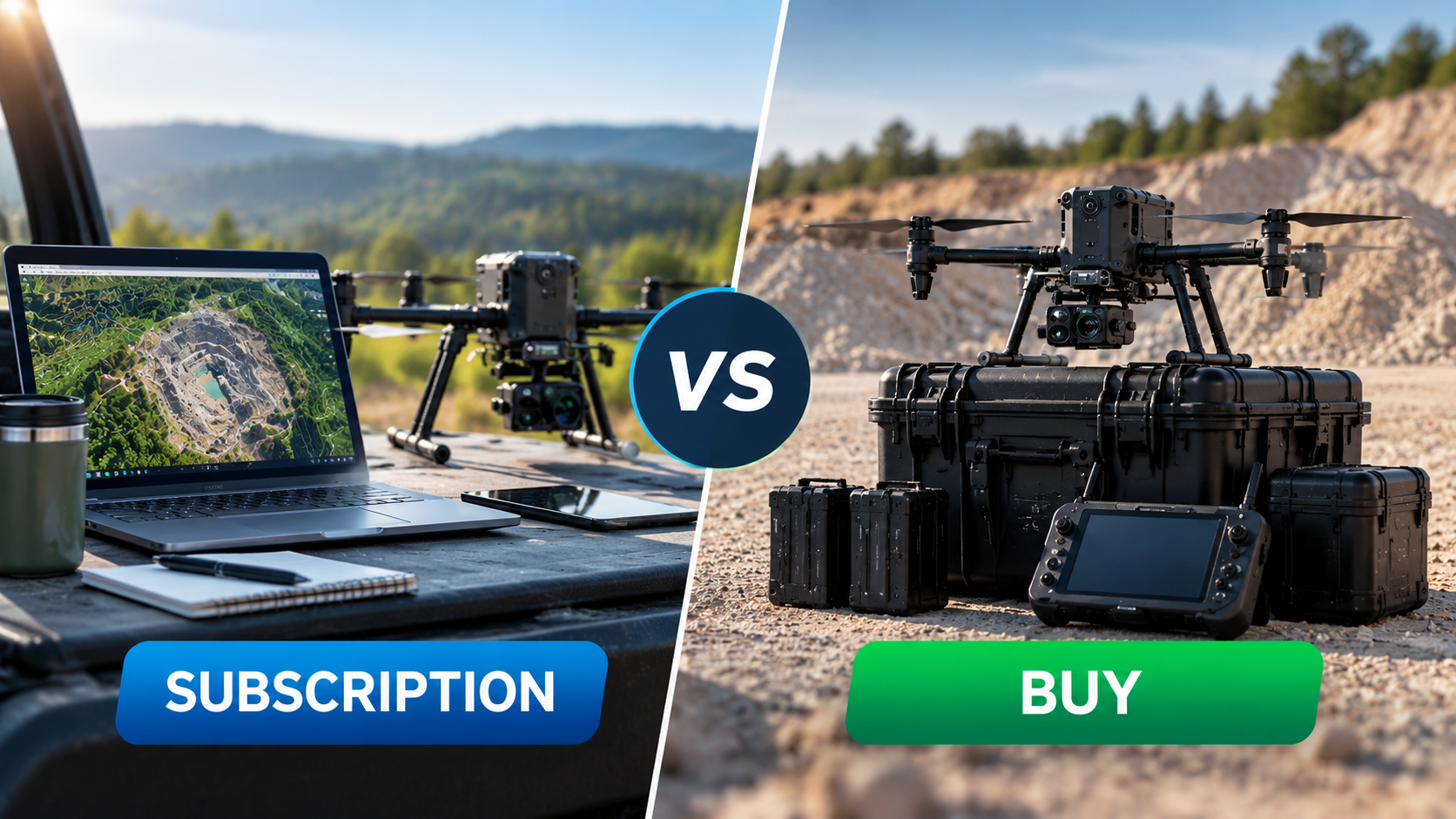
For many survey firms, the decision isn't whether LiDAR works. It's whether now is the right time to invest. Every new project brings the same questions: Can we staff it? Can we deliver it on time? Can we maintain quality without creating more rework?
The better question is: Which model will help your firm complete more projects, reduce rework, and grow profitably without creating new operational bottlenecks?
Today's survey firms face increasing pressure from every direction. Projects are becoming larger and more complex, experienced field personnel remain difficult to recruit and retain, and clients continue to expect faster turnaround times without sacrificing accuracy. At the same time, firms must balance cash flow, staffing, software, training, compliance, and long-term growth.
That is why choosing between buying, subscribing, or outsourcing is about much more than the drone itself. It is a business decision that affects project capacity, profitability, and your ability to scale.
Buying a LiDAR Drone
Buying can be the right decision for firms with consistent project volume and the operational discipline to support an end-to-end drone workflow. When utilization is high and processes are repeatable, ownership often provides the strongest long-term return on investment. However, ownership also requires the greatest commitment.
Beyond the aircraft itself, firms must invest in software, pilot training, quality assurance procedures, data processing, maintenance, spare equipment, and FAA compliance. The true investment extends well beyond the initial purchase price.
Ownership often makes the most sense when your firm:
- Has consistent weekly or monthly project volume that justifies ownership
- Performs repeat work such as topographic mapping, volumetrics, or construction monitoring
- Has internal staff capable of supporting flight operations, processing, and quality assurance
- Wants greater control over scheduling, deliverables, and long-term operating costs
Subscription or Managed Access
Many firms find that a subscription model provides a practical middle ground.
Instead of making a significant upfront investment, subscription programs typically spread costs into predictable monthly payments while providing access to equipment, software, support, and ongoing updates.
For growing survey firms, this approach often preserves cash flow while reducing the burden of managing every aspect of the technology internally.
Subscription models can be a strong fit when your organization:
- Is experiencing steady growth but wants to preserve cash flow
- Needs additional capacity without a significant upfront investment
- Prefers predictable monthly operating expenses over large capital purchases
- Wants ongoing support while developing internal drone capabilities
For many businesses, this approach allows drone operations to mature alongside project demand.
Outsourcing Drone Mapping Services
For firms that need immediate capacity or only require aerial mapping periodically, outsourcing is often the fastest and lowest-risk option.
Rather than investing in equipment, software, training, and operational development, organizations purchase completed deliverables for individual projects.
This allows survey teams to focus on serving clients while experienced professionals manage flight planning, data capture, processing, and quality assurance.
Outsourcing is often ideal when:
- Project demand is seasonal or inconsistent
- Internal teams are already operating at capacity
- Large-area mapping is needed without hiring additional staff
- Immediate project delivery is more important than owning equipment
For many firms, outsourcing also provides an opportunity to evaluate drone workflows before committing to a long-term investment.
Looking Beyond Purchase Price
Many firms underestimate the costs that occur after the drone arrives. Software, data processing, quality assurance, field verification, training, maintenance, and project management often have a greater impact on long-term profitability than the aircraft itself. These operational costs determine whether a drone program becomes a competitive advantage or an expensive piece of equipment that rarely leaves the case. The purchase price of a LiDAR drone is only one part of the financial picture.
When evaluating the total cost of ownership, it's important to look beyond the aircraft itself. Survey firms should also account for:
- Processing software
- Data management
- Pilot training
- FAA compliance
- Maintenance
- Spare batteries and equipment
- Quality assurance
- Office processing time
- Potential rework and return visits
Together, these ongoing operational costs often determine whether a drone program becomes a competitive advantage or an expensive investment that delivers less value than expected. Organizations that evaluate the complete workflow rather than simply comparing hardware prices are typically better positioned to improve profitability and achieve long-term success.
Which Option Makes the Most Sense?
There is no universal answer because every survey firm operates differently.
If your project volume is occasional, outsourcing usually provides the lowest operational risk while allowing your team to access survey-grade deliverables without expanding internal resources.
If demand is increasing and preserving cash flow is a priority, a subscription model often provides the right balance between flexibility, predictable operating costs, and long-term growth.
If your organization has consistent project volume, repeatable workflows, and the internal resources to manage flight operations, processing, and quality assurance, ownership can provide the strongest long-term return.
The goal should never be simply owning technology. The goal is building a workflow that improves productivity, reduces rework, and helps your team deliver accurate survey-grade results more efficiently.
Conclusion
The decision to buy, subscribe, or outsource should be driven by your business—not by the latest technology or the lowest advertised price.
The firms that see the greatest return from drone mapping are the ones that align their investment with project volume, staffing capacity, operational maturity, and long-term growth objectives. They understand that success depends on much more than collecting aerial data. It depends on delivering reliable, survey-grade information that clients can trust.
If you're evaluating your options, don't start with the hardware. Start with your workflow.
Every survey firm has different project demands, staffing realities, and growth objectives. The right decision isn't simply the one with the lowest upfront cost. It's the one that helps your team deliver accurate, repeatable results, reduce rework, protect margins, and create the capacity to take on more projects.
Book a strategy call to discuss your project pipeline, staffing capacity, deliverable requirements, and long-term goals. Together, we'll help you determine whether buying, subscribing, or outsourcing is the best fit for your business so you can make a confident investment that supports sustainable growth.