For most survey firms, drone mapping services are not about flying drones. They are about increasing project capacity, reducing rework, and delivering survey-grade data faster without compromising accuracy or overloading already stretched teams. Projects get larger, schedules get tighter, and clients still expect dependable data that fits directly into design and construction workflows. Meanwhile, the labor market remains tight: the U.S. Bureau of Labor Statistics (BLS) reports median pay of $72,740 for surveyors and $51,940 for surveying and mapping technicians, with about 3,900 surveyor openings and 7,600 technician openings projected each year over the decade. BLS also notes that drones can make certain field tasks more efficient, but technicians are still needed to review and interpret the outputs for accuracy and completeness.
That is the business case for drone mapping services. They help survey firms capture reliable topographic intelligence over large areas, often faster and with fewer field resources than traditional workflows require, without immediately incurring the fixed costs and operational burden of building a complete in-house drone department.
What Drone Mapping Services Actually Deliver
Professional drone mapping services deliver far more than aerial imagery. They produce survey-ready information that engineers, designers, contractors, and project owners can use with confidence. They deliver usable survey information: classified point clouds, surfaces, orthomosaics, contours, stockpile or earthwork measurements, and site documentation that can move into CAD and GIS workflows with minimal cleanup. BLS specifically notes that surveyors and technicians use GIS and CAD to interpret, verify, and present spatial information, which is why the value of a service depends on whether the outputs are ready for those downstream tools.
For survey-grade projects, datum discipline matters as much as the flight itself. NOAA’s National Geodetic Survey warns that coordinates and orthometric heights will change under the modernized National Spatial Reference System, and NOAA’s VDatum tool exists precisely to transform data among horizontal and vertical references. VDatum also supports common coordinate systems such as UTM and State Plane, as well as LiDAR formats including LAS and LAZ. In practical terms, even fast and accurate field collection can create costly office rework if coordinate systems, vertical datums, and file formats are not managed correctly throughout the project: if the service provider cannot manage coordinate systems, vertical datums, and file formats correctly, fast collection in the field can still create expensive rework in the office.
How the Workflow Usually Works
The most effective drone mapping services follow a structured, repeatable workflow designed to produce consistent, survey-grade results from planning through final delivery. They start before takeoff and end after the deliverables are organized, checked, and archived.
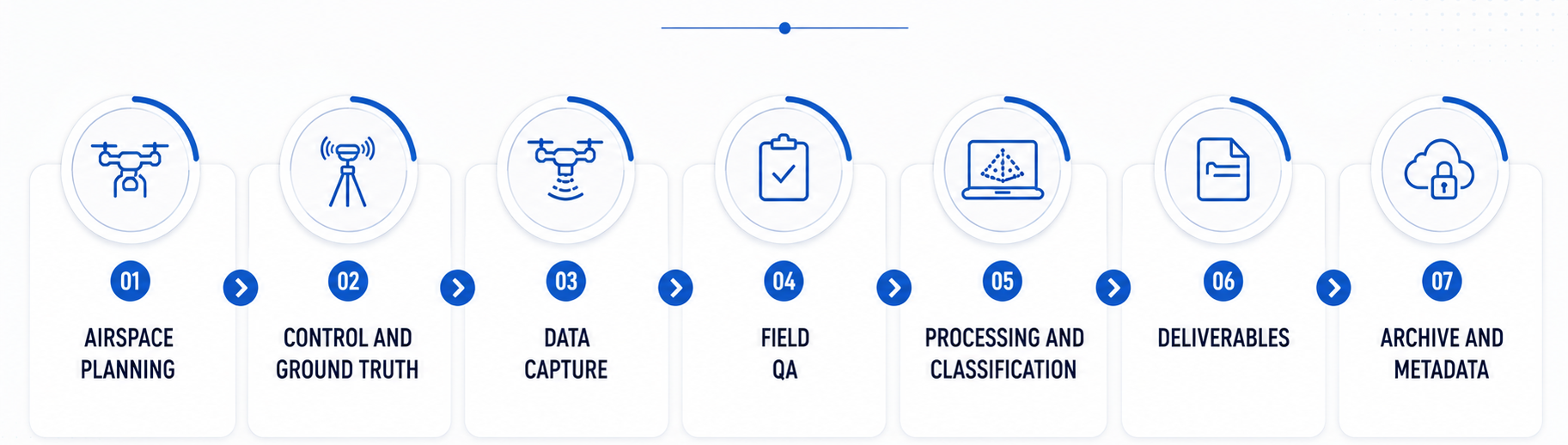
In practice, that means checking airspace first, then confirming control, site conditions, and capture requirements. The FAA requires commercial operators to fly under Part 107 with a Remote Pilot Certificate, most registered business drones must comply with Remote ID, and flights in controlled airspace around airports require FAA authorization before they fly. LAANC can provide near-real-time authorization for many covered airports, but it is still one more planning step that affects schedules.
After capture, the real work begins: field QA to confirm coverage before leaving the site, processing and classification, datum checks, and export into formats that your CAD, GIS, and engineering teams can actually use. That is where a well-managed workflow creates the greatest value by reducing costly mistakes before they become expensive project delays.
When Services Make Sense and When Building an Internal Drone Program Makes Sense
If your company only needs aerial mapping occasionally, or your team is already stretched on field crews and office processing, drone mapping services usually make more sense than buying hardware. That is especially true when you need results now, do not have a certificated pilot on staff, or cannot afford delays caused by ramp-up, training, and QA misses. This is an operational inference, but it follows the facts: FAA compliance obligations do not disappear just because you own the aircraft, and BLS makes clear that skilled people are still required to review outputs and maintain quality.
One way to evaluate your options is to assess project volume, staffing capacity, and workflow maturity rather than the technology itself. If you are flying only a few times per month, services are often the lowest-risk path. If you have steady weekly demand but limited internal processing or QA capacity, a hybrid model can work better. If you have consistent volume, repeatable use cases, and internal leadership ready to own flight operations, processing, and QA, then buying or subscribing starts to look more attractive. The threshold is not just flight frequency. It is whether your firm can support the entire workflow, not merely the aircraft.
Cost, ROI, Training, and Quality Expectations
The most common ownership mistake is pricing the drone but not the operating model. FAA registration is inexpensive at $5 per drone for three years, and recurrent Part 107 training is at no cost every 24 calendar months. Those are not the budget breakers. The higher hidden costs are field control, spare equipment, processing software, data management, office review time, and the cost of a bad deliverable or repeat site visit.
That is why services often produce better early ROI. You are buying turnaround, experience, and rework avoidance. You are also reducing the chance that an internal team learns on a live client project. Even when you outsource, though, your firm still needs to set scope clearly: required accuracy, coordinate system, vertical datum, deliverable format, checkpoints, and acceptance criteria. BLS’s guidance is a useful reality check here: drones improve efficiency, but human review still matters because someone must verify accuracy and completeness.
Conclusion
The best reason to use drone mapping services is not that drones are modern. It is that a good service can help your firm move faster, protect quality, and expand capacity without forcing you to build everything in-house on day one.
If your backlog is growing, your crews are stretched, or your office team is spending too much time cleaning up outside data, now is the right time to compare options. Book a strategy call to review your project volume, staffing reality, accuracy requirements, and deliverable needs. In one conversation, you can usually determine whether a services-first approach, a hybrid model, or in-house ownership will create the strongest return for your firm.